Close
Close

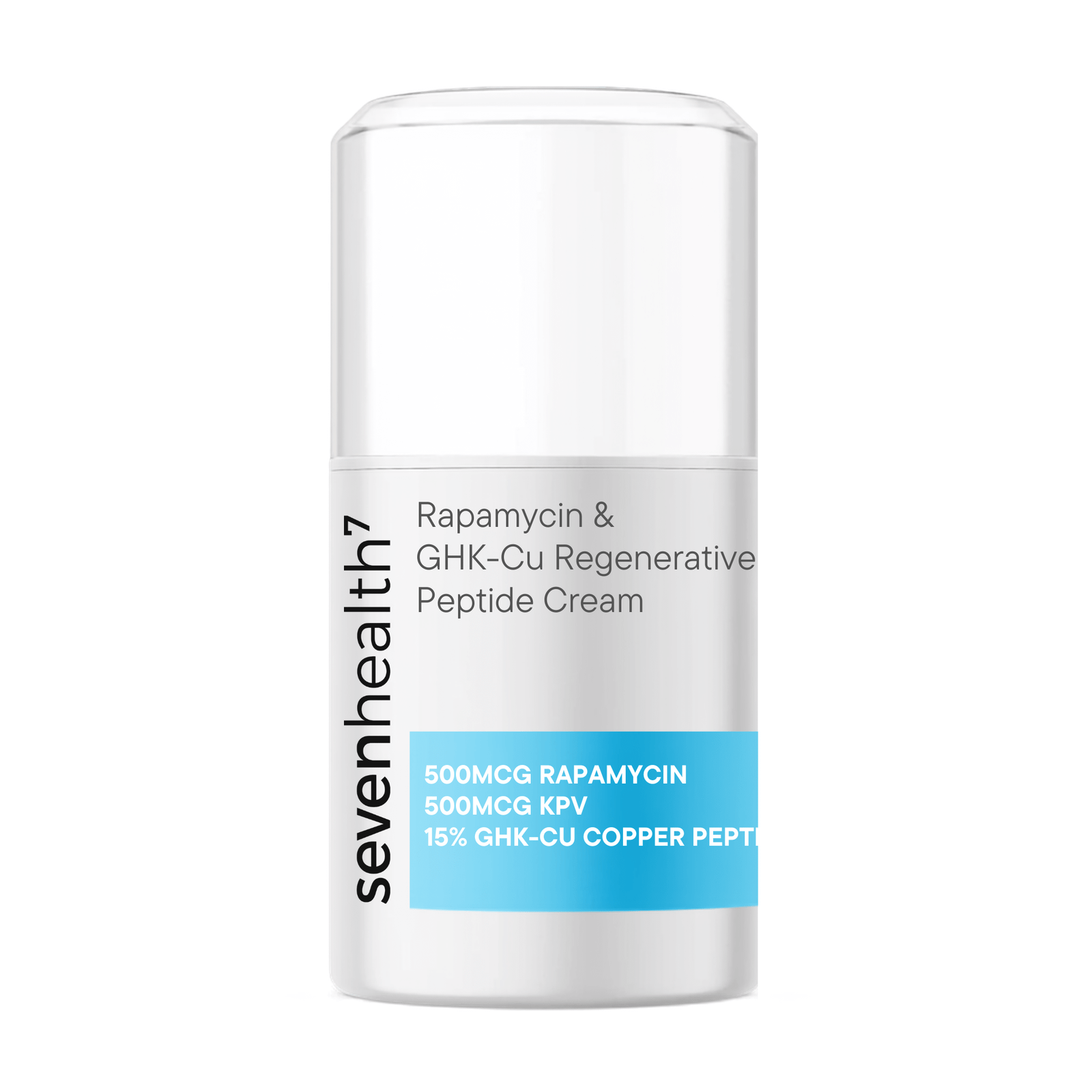
Rapamycin & GHK-Cu Regenerative Peptide Cream 3-Month Membership Program

$1,150.00

4.9 Avg. Rating

1000+ Reviews

Rapamycin & GHK-Cu Regenerative Peptide Cream is a compounded topical treatment that combines two well-studied ingredients: rapamycin, a compound originally developed as an oral medication, and GHK-Cu, a small copper-binding peptide. When combined into a single cream, these two ingredients are commonly used to support the skin’s natural repair and renewal processes.
Rapamycin does not naturally occur in the human body. It was originally discovered in soil bacteria and has been used for decades in oral form for other medical purposes. More recently, researchers have studied a topical, low-dose version of rapamycin for its potential effects on aging skin. GHK-Cu, on the other hand, is naturally found in the human body. It occurs in blood plasma, saliva, and urine, and research shows that natural GHK levels tend to decline as people get older.
Patients typically ask about this cream because they are interested in skin that looks and feels healthier over time. Many people are drawn to the idea of a topical option that may work well alongside other wellness routines, without the need for injections. Because both ingredients have been studied for their roles in skin biology, patients often want to understand how they work together and what results may realistically be expected.
It is important to set accurate expectations from the start. This cream is not a cure for aging, and it will not reverse the aging process. Instead, it is intended to be one part of a broader, medically supervised approach to skin health and healthy aging support.
Think of your skin as a busy construction site that slows down as it gets older. Fewer workers show up, some tools get worn out, and cleanup crews (the cells responsible for clearing out damaged material) don’t work as efficiently as they used to. This cream is designed to support two different parts of that “construction site.” Rapamycin works, in simple terms, by encouraging aging or “worn out” skin cells to settle down and stop sending out signals that can contribute to inflammation and visible skin changes. Researchers sometimes describe these worn-out cells as “senescent” cells. Rather than dividing normally, these cells linger and release substances that may affect the surrounding skin. Low-dose topical rapamycin has been studied for its ability to reduce markers associated with these lingering cells, which may help the surrounding skin look and behave in a more youthful way. GHK-Cu works differently. Picture copper as a key that unlocks certain tools your skin needs to build new collagen, the protein scaffolding that keeps skin firm and structured. GHK-Cu delivers copper directly to the skin in a stable, bound form, which may help support the enzymes responsible for building and maintaining collagen. It is also studied for its role in supporting the skin’s natural repair signals after everyday wear and tear. Together, the idea behind combining these two ingredients is to address skin support from two angles at once: helping reduce the buildup of aging skin cells while also supporting the skin’s rebuilding process. This is why the product is often referred to as a “regenerative” cream, though patients should understand that this reflects the intended supportive mechanism, not a guaranteed outcome.
  • May support a more youthful skin appearance. Early clinical research on topical rapamycin has shown improvements in fine wrinkling and skin tone in some study participants.
  • May help support collagen-related skin structure. GHK-Cu has been studied for its role in supporting collagen production, which is linked to skin firmness.
  • May help promote the skin’s natural repair processes. GHK-Cu has decades of laboratory and clinical research behind its role in wound healing and tissue remodeling.
  • May help reduce visible signs associated with cellular aging in skin. Research on topical rapamycin has focused specifically on markers of cellular senescence in skin tissue.
  • Commonly used to support an overall healthy skin routine as part of a broader wellness and healthy-aging plan.
  • Currently being studied for additional applications, including general skin texture and resilience, though research in these areas is still developing.
People who ask about Rapamycin & GHK-Cu Regenerative Peptide Cream often fall into a few general categories. This is general educational information and is not a recommendation that any particular person use this product. A licensed provider can help determine whether it may be appropriate for you.
  • Adults interested in healthy aging support as part of a broader wellness plan
  • Individuals focused on skin quality and resilience over time
  • Patients already engaged in peptide therapy or longevity-focused care who are curious about topical options
  • People interested in wellness optimization who want to understand the current science behind topical peptides
  • Adults who are interested in supporting skin recovery after normal, everyday environmental exposure
This cream is not intended for use by everyone, and it is not a substitute for sun protection, a healthy lifestyle, or basic skincare fundamentals such as moisturizing and gentle cleansing.
The research behind each ingredient in this cream comes from different bodies of evidence, and it’s important to understand both the strengths and the limitations of what is currently known. GHK-Cu has been studied for nearly four decades, primarily in laboratory (in vitro) research, animal studies, and a number of small human trials. This research has generally focused on collagen production, wound healing, and skin tissue remodeling. Some human studies comparing topical GHK-Cu to other common skincare ingredients have reported improvements in collagen-related measures. Because GHK is a peptide that occurs naturally in the body, researchers have been particularly interested in whether replenishing it topically can support skin that shows signs of aging. Topical rapamycin has a shorter research history when it comes to skin-specific use. A notable exploratory, placebo-controlled human trial conducted at a university dermatology center evaluated low-dose topical rapamycin applied over several months. That study reported reductions in a specific protein marker associated with cellular senescence, along with visible improvements in some participants’ skin appearance. However, this was a small, exploratory study, and a meaningful portion of enrolled participants did not complete the full study period. This means the findings, while promising, should be considered preliminary rather than definitive. Importantly, no published research currently evaluates the specific combination of rapamycin and GHK-Cu together in a single cream. Each ingredient has its own separate body of research, and the theoretical rationale for combining them is based on their differing, potentially complementary mechanisms. Individual results can vary significantly, and researchers continue to study optimal concentrations, application frequency, and long-term outcomes for both ingredients. Patients should understand that this is an evolving area of skin science, not an established, standardized treatment protocol.
Because this cream contains rapamycin, a compound with a well-established medical history in other contexts, medical supervision is an important part of using it safely. Possible side effects that have been reported with topical rapamycin and copper peptide products may include mild skin irritation, redness, dryness, or a temporary stinging sensation at the application site. Some individuals may experience an allergic reaction to any topical product. As with most topical actives, sensitivity can vary from person to person. This cream may not be appropriate for everyone. People who are pregnant or breastfeeding, individuals with known allergies to any ingredient in the formulation, and people with certain skin conditions or open wounds in the treatment area should discuss this with their provider before use. Patients taking other medications, particularly other immune-related therapies, should disclose their full medication history so their provider can evaluate for any potential interactions. Medical supervision matters because a licensed provider can review your health history, help you understand how to apply the cream correctly, and monitor for any unexpected reactions. Skipping this step or using compounded peptide products without guidance increases the risk of irritation or ineffective use. Following your prescribed treatment plan as directed by your provider, including the recommended application frequency and areas of use, is an important part of using this therapy safely and as intended. This is general safety information only. It is not a complete list of risks or contraindications. Your provider will review your individual health history during your consultation.

What does Rapamycin & GHK-Cu Regenerative Peptide Cream do?

It is a topical cream that may help support the skin’s natural collagen-building processes while also helping to reduce markers associated with aging skin cells.

How long before I may notice changes?

Research on similar formulations suggests that visible changes, when they occur, are generally noticed gradually over several weeks to months. Individual results vary.

Is it an injection?

No. This is a topical cream applied directly to the skin, not an injectable peptide.

Can it be combined with other peptides?

Some patients use topical peptide creams alongside other prescribed peptide therapies. Your provider can help determine what combination, if any, is appropriate for your specific plan.

Can it be combined with GLP-1 medications?

There is no known conflict between topical peptide creams and GLP-1 medications, but your provider will review your full treatment plan to confirm this is appropriate for you.

Will I need lab work?

Lab work is not always required for a topical cream, but your provider may recommend it depending on your overall health history and treatment goals.

Who should avoid this peptide cream?

Individuals who are pregnant or breastfeeding, those with known allergies to the ingredients, or anyone with significant skin conditions in the treatment area should speak with a provider before starting. A full evaluation will help determine appropriateness.

How long do patients typically remain on therapy?

Treatment length varies by individual and is determined by your provider, but many peptide therapy programs are structured around three-month treatment periods with follow-up evaluation.

Is a consultation required?

Yes. A telehealth consultation with a licensed provider is required before starting treatment to ensure it is appropriate for your health history and goals.

Does this cream replace daily sunscreen or skincare?

No. This cream is meant to complement, not replace, basic skincare fundamentals like sun protection, gentle cleansing, and moisturizing.
Every peptide treatment program at SevenHealth is designed to be thorough, transparent, and medically guided from start to finish. When you begin treatment, you can expect:
  • An initial telehealth medical history and comprehensive evaluation with a licensed medical provider
  • Review of previous laboratory results when available, or recommendations for laboratory testing when medically appropriate
  • Personalized treatment recommendations based on your medical history and personal goals
  • Three months of prescribed peptide therapy when medically appropriate
  • A customized dosing and application schedule specific to your prescribed cream
  • A comprehensive follow-up appointment approximately three months after starting treatment
  • Review of your progress, discussion of results, treatment adjustments if medically appropriate, and continued provider guidance
  • Ongoing provider oversight throughout your treatment program
  • No additional fees for appointments included within the treatment program
  • No additional fees for laboratory review as part of your treatment
At SevenHealth, our goal is to make peptide therapy simple and transparent. From your very first consultation to your follow-up visit, you’ll have a licensed provider guiding you through each step, so you always know what to expect and never feel like you’re navigating your treatment plan alone.
Patients choose SevenHealth because our approach centers on individualized, medically supervised care rather than one-size-fits-all treatment. Every treatment plan is built around your specific health history and goals, and every prescription is guided by a licensed medical provider from start to finish. We work with FDA-registered 503A U.S. compounding pharmacies that follow applicable quality standards, so patients can feel confident in the sourcing and preparation of their prescribed therapy. Dosing is provider-guided rather than self-directed, and ongoing medical supervision continues throughout your treatment period. Every program includes a three-month follow-up appointment to review your progress and make adjustments if medically appropriate. Transparent pricing is also part of our approach. There are no surprise appointment fees or laboratory review fees within your treatment program, so you know what to expect from day one.
  • Rapamycin & GHK-Cu Regenerative Peptide Cream combines two differently studied ingredients: topical rapamycin and the copper peptide GHK-Cu.
  • GHK-Cu occurs naturally in the body and has decades of research behind its role in collagen support and wound healing.
  • Topical rapamycin has been studied in a small, exploratory human trial for its effects on markers of skin cell aging.
  • No published research currently evaluates this specific combination cream directly.
  • This cream may help support collagen-related skin structure and may help reduce visible signs associated with aging skin cells, but individual results vary.
  • It is not a cure for aging skin and should not replace fundamental skincare habits like sun protection.
  • Medical supervision is important due to the inclusion of rapamycin and the need to evaluate individual health history.
  • A telehealth consultation with a licensed provider is required before starting treatment.

Educational Disclaimer

This information is provided for educational purposes only and is not intended to diagnose, treat, cure, or prevent any disease. Peptide therapy should only be used under the supervision of a licensed healthcare provider after an appropriate medical evaluation. Individual results may vary.

$100 OFF GLP-1 Injectable Plans for New Members ! CODE: