Close
Close

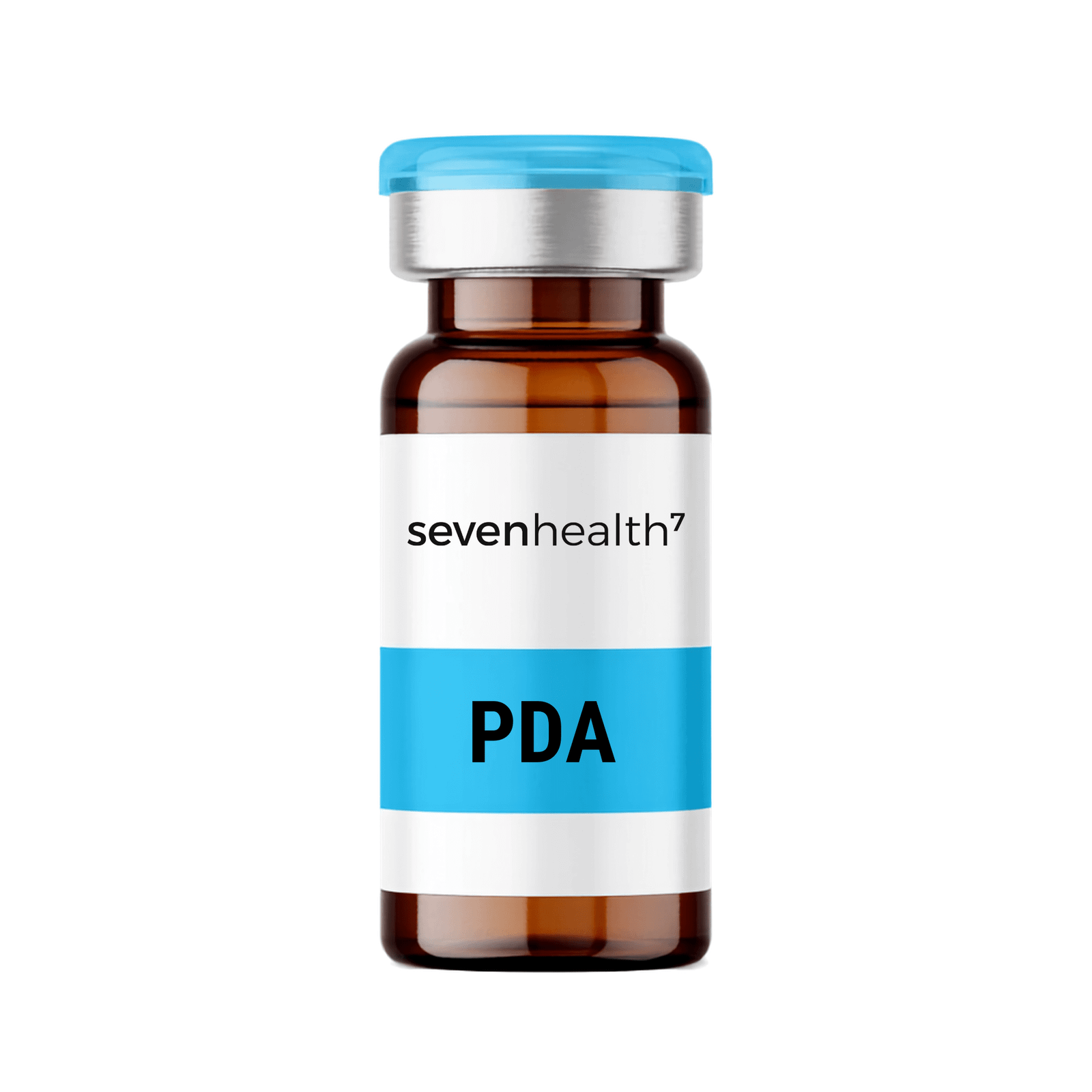
Penta-Deca-Arginate (PDA) 3-Month Membership Program

$1,750.00

4.9 Avg. Rating

1000+ Reviews

Pentadeca Arginate, often shortened to PDA, is a peptide that patients frequently ask about, especially those who have already heard of a related and more widely known compound called BPC-157. Because these two names come up together so often, it’s important to start with a clear, honest explanation of how they relate to one another.
PDA shares the exact same 15 amino acid sequence as BPC-157, a peptide originally based on a fragment of a protective protein found in human gastric juice. The difference between the two lies in the salt form used in manufacturing: BPC-157 is conventionally produced using an acetate salt, while PDA uses an arginine-based salt instead. This is a manufacturing and formulation difference, not a change to the peptide’s core active structure.
Patients commonly ask about PDA because, in recent years, it has often been offered by compounding pharmacies as an alternative name or form when BPC-157 itself faced periods of regulatory restriction. Because PDA is chemically the same active peptide sequence as BPC-157, essentially all of the available research discussed for BPC-157 also applies to PDA, since no separate, dedicated clinical studies have been conducted specifically on the arginate salt form as a distinct compound.
This page is designed to give you that same honest picture, since understanding PDA really means understanding BPC-157’s research and its evolving regulatory status, which your provider can walk you through in more detail.
To understand how PDA works, it helps to know that its mechanism of action is identical to that of BPC-157, since they share the same active amino acid sequence. Picture your body’s repair system like a construction crew that needs good road access, meaning blood flow, and clear instructions, meaning chemical signals, to properly fix damaged tissue. PDA is studied, through its shared identity with BPC-157, for its potential role in supporting the growth of new small blood vessels, a process called angiogenesis, which may help deliver oxygen and nutrients to injured tissue. It has also been examined for its relationship with nitric oxide, a molecule involved in blood vessel function. The arginate salt form is specifically discussed for its potential to improve the peptide’s stability, particularly in acidic environments like the digestive tract, which may be relevant for oral formulations. However, for injectable use, which bypasses the digestive tract, this specific advantage is less relevant, since both salt forms deliver the same active peptide sequence to the body.
  • Is currently being studied for its potential role in supporting tissue repair, based on the extensive body of research conducted on its shared active sequence, BPC-157
  • Has shown promise in research related to protecting and supporting the lining of the digestive tract, consistent with the shared origin as a gastric-protective compound
  • May offer improved stability in certain formulations, particularly oral use, due to the arginate salt form’s resistance to breakdown in acidic environments
  • May be of interest to patients exploring recovery support after physical activity or minor soft-tissue strain, though this remains an area with limited human data
Because PDA has not been separately studied as a distinct compound in human clinical trials, and because essentially all available research applies to its shared sequence with BPC-157, these potential benefits should be understood as extending directly from BPC-157’s research, which itself remains largely limited to animal and laboratory studies.
Patients who commonly ask about PDA include those interested in:
  • Athletic recovery, particularly active adults curious about peptide-based support for muscle, tendon, or ligament strain
  • Gut health support, for patients interested in the compound’s original research context involving the digestive tract
  • Wellness optimization, for patients working with a provider on a broader recovery and wellness plan
PDA is not appropriate for everyone, and given the limited human research currently available for its shared active sequence, it requires a thorough and honest conversation with a licensed provider about realistic expectations before starting.
Because PDA and BPC-157 share the identical 15-amino-acid active sequence, the available research picture is effectively the same for both. This includes an extensive body of animal and laboratory research spanning several decades and multiple tissue types, including the digestive tract, muscle, tendon, ligament, and nerve tissue. It’s important to be transparent that no dedicated, peer-reviewed clinical trials have investigated Pentadeca Arginate specifically as a distinct compound from BPC-157. A comprehensive review of the available literature has found this to be the case, meaning that any claims of unique or enhanced effectiveness for the arginate salt form, beyond stability differences relevant mainly to oral dosing, are not yet supported by dedicated human research. Similarly, human clinical trial data on the underlying peptide sequence itself remains quite limited compared to the extensive animal research base, as discussed in more detail on our dedicated BPC-157 page. The regulatory status of this peptide sequence, under either name, has also evolved over time, and compounding availability continues to be actively reviewed by the FDA. Because of this, your provider is the best source for the most current, accurate information about availability and appropriate use at the time of your consultation.
Because PDA shares BPC-157’s active sequence, available safety information generally reflects a favorable side effect profile in existing research, with commonly reported effects limited to mild injection site reactions. However, because comprehensive human safety data, particularly for long-term use, remains limited for the underlying peptide sequence, this should be approached with appropriate caution rather than assumed to be risk-free. Because this peptide sequence does not have FDA approval and human research is still developing, it requires an especially thorough and honest conversation with your provider about the current state of the evidence, regardless of which salt form or name is used. Patients with certain active health conditions may not be appropriate candidates, and only a licensed provider reviewing your full medical history can help you understand whether this is a reasonable area to explore. Ongoing medical supervision is especially important given the still-evolving safety and research picture. Patients should never source or use this peptide outside of a properly supervised medical relationship.

What does PDA do?

PDA shares the same active sequence as BPC-157 and is studied for its potential role in supporting tissue repair, blood vessel growth, and digestive tract protection.

Is PDA the same as BPC-157?

The active peptide sequence is identical. The difference is the salt form used in manufacturing, arginate versus the more conventional acetate, which may affect stability but not the core active structure.

Is PDA FDA-approved?

No. Neither PDA nor BPC-157 has FDA approval for any use, and their regulatory status for pharmacy compounding has changed over time as the FDA continues to review available data.

How long before I may notice changes?

Responses vary considerably, and because dedicated human research on this specific salt form doesn’t exist, there is no well-established timeline for expected results.

Is it an injection?

PDA is typically administered as a subcutaneous injection, and some formulations may also be available orally given the arginate salt’s improved stability in that context.

Can it be combined with other peptides?

Some providers combine PDA with other peptides, such as growth hormone secretagogues. This should always be discussed with your provider first.

Can it be combined with GLP-1 medications?

This should be discussed individually with your provider as part of your overall treatment plan.

Will I need lab work?

Your provider may recommend baseline evaluation as part of a thorough, individualized approach to this peptide.

Who should avoid this peptide?

Patients with certain active health conditions may not be appropriate candidates. A full medical evaluation will help determine this, especially given the limited human safety data currently available.

Is a consultation required?

Yes. A telehealth consultation with a licensed medical provider is required before starting PDA or any peptide therapy at SevenHealth.
Every peptide treatment program at SevenHealth is built around comprehensive, individualized medical care. When you begin therapy, your program includes:
  • An initial telehealth medical history and comprehensive evaluation with a licensed medical provider
  • Review of previous laboratory results when available, or recommendations for laboratory testing when medically appropriate
  • Personalized treatment recommendations based on your medical history and goals
  • Three months of prescribed peptide therapy when medically appropriate
  • A customized dosing and titration schedule specific to your prescribed peptide
  • A comprehensive follow-up appointment approximately three months after starting treatment
  • Review of progress, discussion of results, treatment adjustments if medically appropriate, and continued provider guidance
  • Ongoing provider oversight throughout your treatment program
  • No additional fees for appointments included within the treatment program
  • No additional fees for laboratory review as part of your treatment
Our goal is to make your experience with peptide therapy simple, transparent, and medically supervised from your very first consultation through every follow-up appointment. Given the evolving research and regulatory picture surrounding this peptide sequence, your provider will keep you informed of current availability and realistic expectations throughout your care.
Patients choose SevenHealth because we focus on individualized, medically supervised care rather than one-size-fits-all protocols. Every treatment plan is built around your specific health history and goals, and every prescription is overseen by a licensed medical provider from start to finish. We work with FDA-registered 503A U.S. compounding pharmacies that follow applicable quality standards, so you can feel confident in the source and handling of your prescribed peptide therapy, to the extent current regulations allow. Dosing is guided by your provider, not guesswork, and every program includes a three-month follow-up to review your progress and make adjustments if needed. We also believe in transparent pricing and honest education. There are no surprise appointment fees or lab review fees hidden within your treatment program, and we believe in giving patients a clear, accurate picture of where the science and regulatory landscape currently stand.
  • Pentadeca Arginate (PDA) shares the identical 15-amino-acid active sequence with BPC-157; the difference is the salt form used in manufacturing.
  • No dedicated human clinical trials have studied PDA separately from BPC-157, so all available research applies to the shared underlying sequence.
  • The arginate salt form may offer improved stability, particularly for oral use, though this is a formulation consideration rather than a difference in core activity.
  • Most existing research on this peptide sequence comes from animal and laboratory studies, with limited human clinical trial data.
  • Its FDA regulatory status for compounding has changed multiple times and continues to be actively reviewed.
  • Reported side effects appear mild in available data, but comprehensive long-term human safety information remains limited.
  • This peptide requires an especially thorough, honest conversation with your provider given the current state of the evidence.
  • SevenHealth includes an initial evaluation, personalized dosing, lab review, and a three-month follow-up in every treatment program.

Educational Disclaimer

This information is provided for educational purposes only and is not intended to diagnose, treat, cure, or prevent any disease. Peptide therapy should only be used under the supervision of a licensed healthcare provider after an appropriate medical evaluation. Individual results may vary.

$100 OFF GLP-1 Injectable Plans for New Members ! CODE: