Close
Close

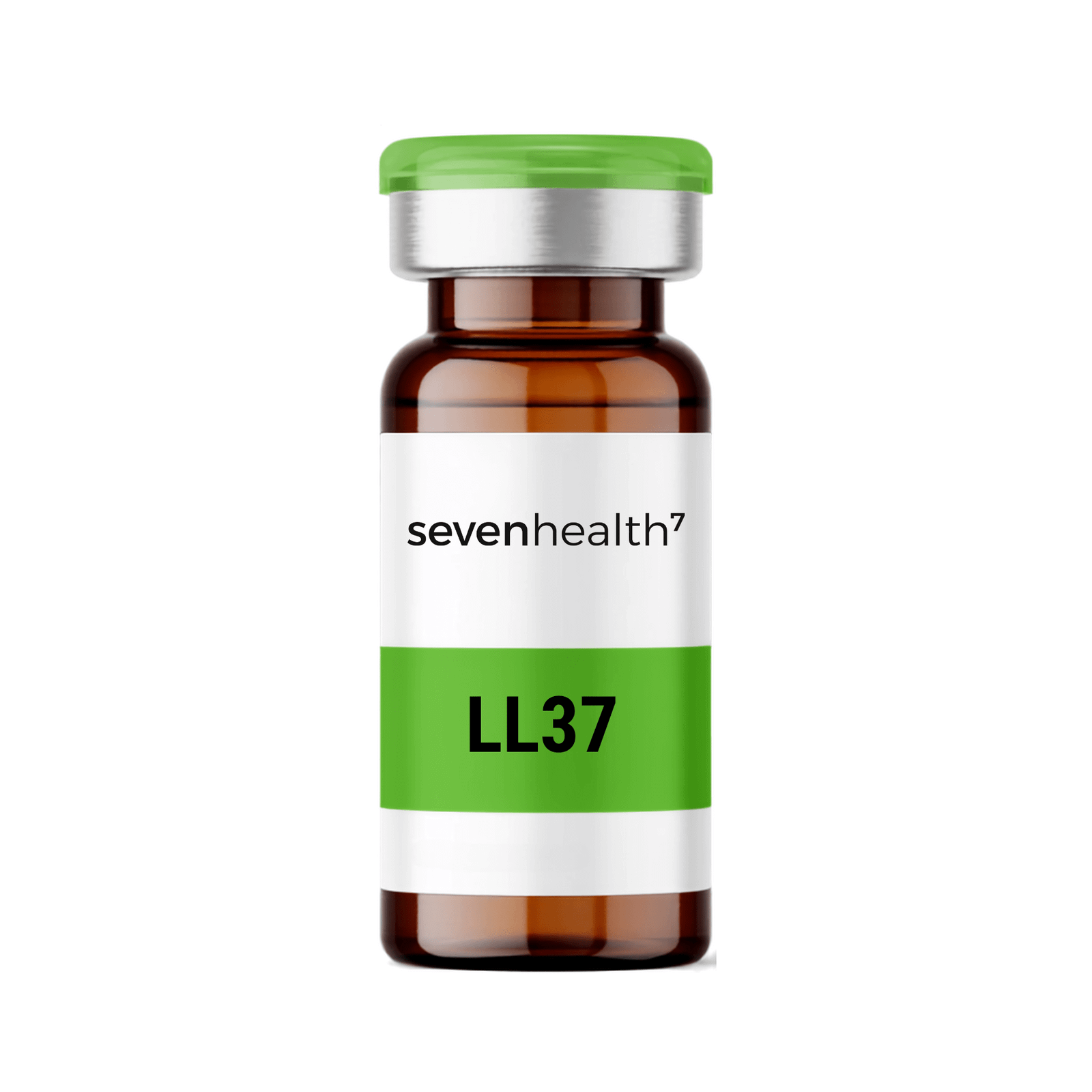
LL37 3-Month Membership Program

$1,550.00

4.9 Avg. Rating

1000+ Reviews

LL-37 is a peptide that patients sometimes ask about after learning it’s the only member of a specific family of natural defense molecules that the human body produces on its own. Because it plays a genuine role in your body’s everyday defenses, it has drawn interest from researchers studying both infection defense and wound healing.
LL-37 is a naturally occurring peptide that belongs to a family called cathelicidins. It’s produced by several types of cells in your body, including certain white blood cells and the cells that make up your skin, as part of your innate immune system, which is your body’s first line of defense against germs. LL-37 is unique in that it’s the only cathelicidin peptide that humans produce, whereas many other animals have several different versions.
Patients commonly ask about LL-37 because of its dual role: it has both direct antimicrobial properties, meaning it can act against certain bacteria, and it appears to play a role in supporting wound healing. This combination has made it a peptide of interest in research related to skin health, wound care, and immune defense.
It’s important to understand that LL-37 does not currently have FDA approval for any use, and human clinical research remains at an earlier stage compared to the extensive laboratory research that has been conducted on this peptide. This page aims to give you an honest, accurate picture of where the science currently stands.
To understand how LL-37 works, picture your skin and immune system like a security team with two different jobs: directly stopping intruders and helping repair any damage after a break-in. LL-37 is studied for its ability to do both. On the defense side, LL-37 is thought to work by directly disrupting the outer membrane of certain bacteria, essentially puncturing their protective outer layer. This direct action is different from how many antibiotics work, which is part of why researchers have found LL-37 interesting as a potential tool against certain hard-to-treat bacterial infections, including those that form protective communities called biofilms. On the repair side, LL-37 has also been studied for its role in supporting the skin’s healing process after injury, including effects on the cells responsible for closing wounds and rebuilding tissue. Researchers believe LL-37 may help coordinate these two roles, defense and repair, as part of your skin and immune system’s overall response to injury or infection.
  • Has shown promise in research for its natural antimicrobial and anti-biofilm activity against certain bacteria, based on laboratory studies
  • Is currently being studied for its potential role in supporting wound healing, particularly in topical applications for certain types of chronic wounds
  • May be of interest in research related to skin barrier health and the body’s natural innate immune defenses
  • Has shown early clinical promise in a topical wound-healing trial, though this represents an early stage of human research rather than an established treatment
Because most of the available evidence on LL-37 comes from laboratory research, with only a limited number of early-phase human trials completed, these potential benefits should be understood as promising, developing areas of research rather than established, guaranteed outcomes.
Patients who commonly ask about LL-37 include those interested in:
  • Wound healing support, particularly patients interested in the compound’s studied role in tissue repair
  • Immune defense, for patients interested in the body’s natural antimicrobial systems
  • Skin health, for patients exploring peptides related to the skin’s barrier and defense functions
  • Wellness optimization, for patients working with a provider on a broader immune and skin health plan
LL-37 is not appropriate for everyone, and given its early-stage research status, it requires a thorough medical evaluation before starting, along with realistic expectations about what the current evidence supports.
LL-37 has been studied extensively in laboratory research examining its antimicrobial, anti-biofilm, and wound-healing properties. This research has explored its activity against a range of bacteria, including some that are difficult to treat because they form protective biofilm communities, as well as its effects on skin cells involved in the wound-healing process. Human clinical research on LL-37 is more limited but growing. The most advanced human data available comes from topical wound-healing trials, including a placebo-controlled study that found a meaningfully higher rate of complete wound closure in a specific group of larger wounds treated with LL-37 compared to placebo. This represents encouraging early clinical evidence, though it remains focused on a specific topical application rather than broader systemic use. It’s important to be transparent that LL-37 does not currently have FDA approval for any indication, and as of now it’s only available as a compounded prescription through licensed providers and compounding pharmacies. Much of the broader interest in LL-37, including its potential relevance to conditions like psoriasis and its role in general immune and skin health, remains at the research stage rather than being supported by large, confirmatory human trials. Ongoing research continues to explore its potential applications, and individual responses can be expected to vary.
Available research on LL-37, particularly in the context of topical wound applications, has generally not identified major safety concerns, though the overall human safety database remains smaller than for more established therapies. As with any peptide at this stage of research, ongoing medical supervision is important to help identify and manage any unexpected effects. Because LL-37 affects both immune and skin biology, certain patients may require additional consideration before starting this peptide. Patients with active skin conditions or certain immune-related conditions should have a careful conversation with their provider. This is not a complete list of contraindications, and only a licensed provider reviewing your full medical history can determine whether LL-37 is a safe and appropriate option for you. Patients should only obtain LL-37 through licensed, quality-controlled sources, such as a properly regulated compounding pharmacy, rather than unregulated online vendors, and should follow their provider’s guidance closely throughout treatment.

What does LL-37 do?

LL-37 is studied for its natural antimicrobial activity against certain bacteria and its potential role in supporting wound healing and skin barrier function.

Is LL-37 FDA-approved?

No. LL-37 is not FDA-approved for any indication and is currently available only as a compounded prescription through licensed providers.

How long before I may notice changes?

This depends heavily on the reason for use, and given the early stage of human research, your provider can help set realistic, individualized expectations.

Is it an injection?

LL-37 can be used topically or by injection depending on the intended use, and your provider will discuss the appropriate approach for your situation.

Can it be combined with other peptides?

This should be discussed with your provider, who can evaluate your full treatment plan and goals.

Can it be combined with GLP-1 medications?

This is not a well-studied combination, and should be discussed individually and carefully with your provider.

Will I need lab work?

Your provider may recommend baseline evaluation as part of an individualized approach to this peptide.

Who should avoid this peptide?

Patients with active skin conditions or certain immune-related conditions should have a careful conversation with their provider. A full medical evaluation will help determine appropriateness.

How long do patients typically remain on therapy?

This varies significantly depending on the reason for use, and your provider will help determine an appropriate, individualized plan.

Is a consultation required?

Yes. A telehealth consultation with a licensed medical provider is required before starting LL-37 or any peptide therapy at SevenHealth.
Every peptide treatment program at SevenHealth is built around comprehensive, individualized medical care. When you begin therapy, your program includes:
  • An initial telehealth medical history and comprehensive evaluation with a licensed medical provider
  • Review of previous laboratory results when available, or recommendations for laboratory testing when medically appropriate
  • Personalized treatment recommendations based on your medical history and goals
  • Three months of prescribed peptide therapy when medically appropriate
  • A customized dosing and titration schedule specific to your prescribed peptide
  • A comprehensive follow-up appointment approximately three months after starting treatment
  • Review of progress, discussion of results, treatment adjustments if medically appropriate, and continued provider guidance
  • Ongoing provider oversight throughout your treatment program
  • No additional fees for appointments included within the treatment program
  • No additional fees for laboratory review as part of your treatment
Our goal is to make your experience with peptide therapy simple, transparent, and medically supervised from your very first consultation through every follow-up appointment. You will always know what to expect, what you’re paying for, and who to reach out to with questions along the way.
Patients choose SevenHealth because we focus on individualized, medically supervised care rather than one-size-fits-all protocols. Every treatment plan is built around your specific health history and goals, and every prescription is overseen by a licensed medical provider from start to finish. We work with FDA-registered 503A U.S. compounding pharmacies that follow applicable quality standards, so you can feel confident in the source and handling of your prescribed peptide therapy. Dosing is guided by your provider, not guesswork, and every program includes a three-month follow-up to review your progress and make adjustments if needed. We also believe in transparent pricing. There are no surprise appointment fees or lab review fees hidden within your treatment program, so you always know what you’re paying for.
  • LL-37 is the only cathelicidin antimicrobial peptide produced naturally by humans, playing a role in innate immune defense and wound healing.
  • It has direct antimicrobial and anti-biofilm activity against certain bacteria, studied extensively in laboratory research.
  • Early human clinical trials, particularly for topical wound applications, have shown encouraging results, though the human evidence base remains limited.
  • LL-37 is not FDA-approved and is currently available only as a compounded prescription through licensed providers.
  • Patients with active skin or immune-related conditions should have a careful conversation with their provider before starting.
  • Product quality and sourcing matter significantly for this peptide, given its biological complexity.
  • This therapy requires a full medical evaluation and ongoing supervision.
  • SevenHealth includes an initial evaluation, personalized dosing, lab review, and a three-month follow-up in every treatment program.

Educational Disclaimer

This information is provided for educational purposes only and is not intended to diagnose, treat, cure, or prevent any disease. Peptide therapy should only be used under the supervision of a licensed healthcare provider after an appropriate medical evaluation. Individual results may vary.

$100 OFF GLP-1 Injectable Plans for New Members ! CODE: