Close
Close

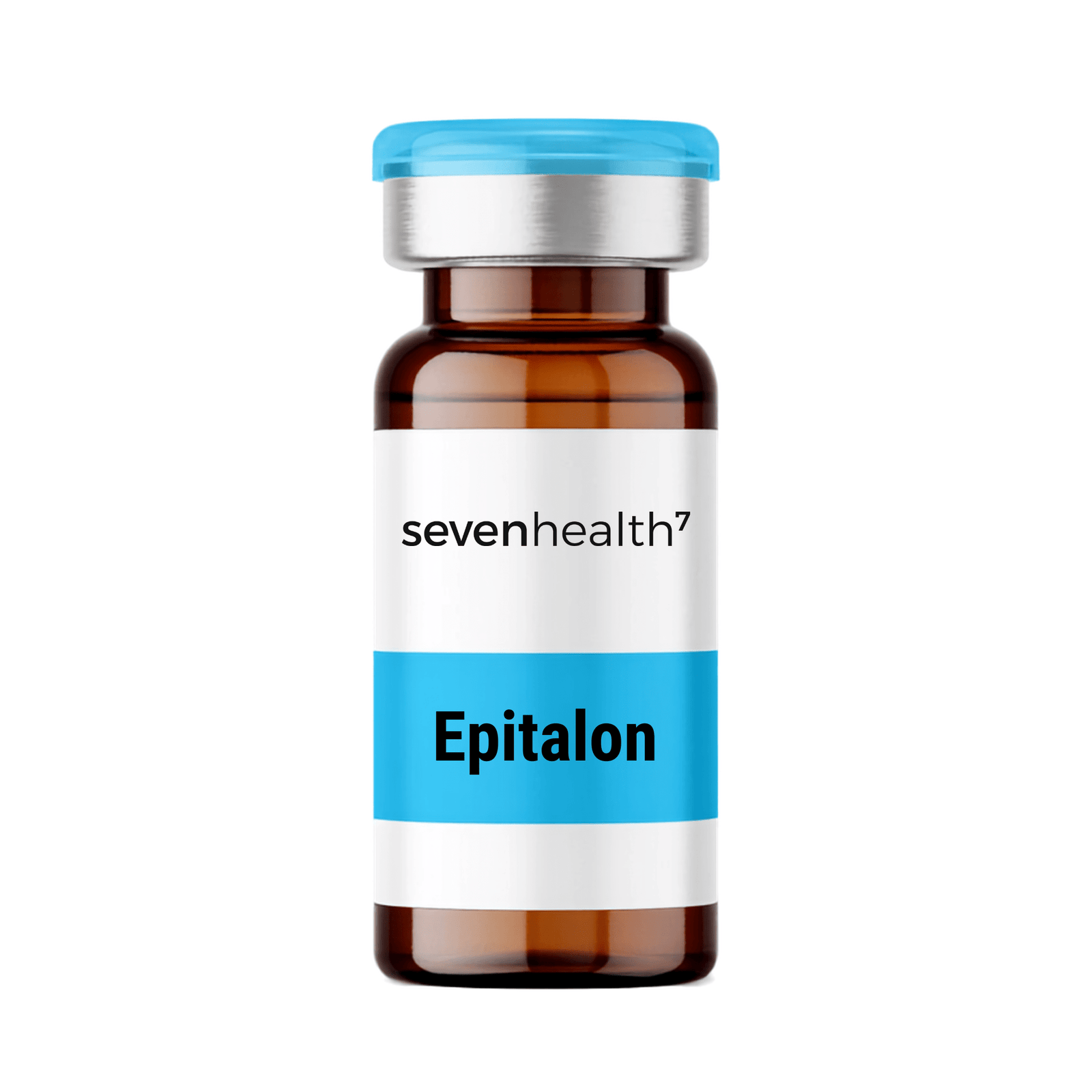
Epitalon 3-Month Membership Program

Price range: $1,050.00 through $1,550.00

4.9 Avg. Rating

1000+ Reviews

Epitalon, also known as Epithalon, is a peptide that has drawn interest in the longevity and healthy aging space because of its connection to two areas of biology: the pineal gland and the way our cells age over time. Patients often ask about it after reading about “anti-aging peptides” and wanting to understand what the actual science says, separate from marketing claims.
Epitalon is a small, four-amino-acid peptide originally studied as a synthetic version of a natural compound found in the pineal gland, a small gland in the brain best known for producing melatonin and helping regulate our sleep-wake cycle. Researchers became interested in Epitalon because of its association with a process called telomerase activity, which relates to the protective caps on the ends of our chromosomes called telomeres.
Telomeres are often compared to the plastic tips on the ends of shoelaces. They protect the genetic material inside each cell, and they naturally shorten a little each time a cell divides. This shortening process is one of many factors researchers associate with cellular aging. Epitalon has been studied for its potential role in supporting the enzyme responsible for maintaining telomere length, which is part of why it has become a topic of interest in longevity research.
It’s important for patients to understand that Epitalon is not a proven way to reverse aging or extend human lifespan. Much of the research on Epitalon comes from laboratory and animal studies, with a more limited amount of human research available. This peptide is best understood as an area of ongoing scientific interest rather than a settled, guaranteed solution.
To understand Epitalon, it helps to picture your cells’ chromosomes like shoelaces, with telomeres acting as the protective plastic caps at each end. Every time a cell divides, those caps get a little shorter. Once they become too short, the cell can no longer divide properly, which is one of the processes researchers link to cellular aging. Epitalon is studied for its potential to support the activity of an enzyme called telomerase, which acts like a small repair crew that can help rebuild those protective caps. Laboratory research has explored whether Epitalon may help activate this “repair crew” in certain cell types, which is why it’s often discussed in conversations about cellular aging and longevity. Separately, Epitalon is also studied for its connection to the pineal gland and melatonin production. Because the pineal gland helps regulate your internal body clock, or circadian rhythm, researchers have looked at whether Epitalon may play a role in supporting healthy sleep-wake patterns, particularly as this rhythm can become less consistent with age. These two areas, cellular aging and circadian rhythm, represent the two main pathways researchers are exploring when they study Epitalon, though the exact mechanisms are still being investigated and are not yet fully understood.
  • Is currently being studied for its potential role in supporting telomerase activity and cellular aging processes
  • May help support healthy circadian rhythm, given its studied connection to the pineal gland and melatonin regulation
  • May assist with sleep quality for some patients, related to its potential effects on the body’s natural sleep-wake cycle
  • Has shown promise in early research as part of the broader scientific interest in cellular longevity, though most of this research remains preclinical
  • May be used as part of a broader healthy aging wellness plan, alongside lifestyle factors like nutrition, activity, and sleep hygiene
Because much of the existing research is still in early stages, these potential benefits should be understood as areas of ongoing study rather than guaranteed outcomes.
Patients who commonly ask about Epitalon include those interested in:
  • Healthy aging, particularly adults interested in the science of cellular aging and longevity
  • Wellness optimization, especially patients already working with a provider on a broader healthy aging plan
  • Longevity-focused wellness, for patients who follow emerging research in this space and want a medically supervised way to explore it
  • Circadian rhythm and sleep support, for patients noticing changes in their sleep-wake patterns over time
Epitalon is not intended for everyone, and it should never be started without a proper medical evaluation. Your provider will help determine whether this is a reasonable option based on your health history and goals.
Epitalon’s research history traces back to work on a related natural pineal extract, and much of the foundational research has been conducted by research groups studying peptide bioregulators and their effects on aging processes. Laboratory studies using human cell cultures have explored Epitalon’s effects on telomerase activity, and animal studies have examined its relationship to melatonin rhythms and markers associated with aging. It’s important to be transparent that this body of research is still developing, and much of it comes from laboratory (in vitro) and animal studies rather than large, independently replicated human clinical trials. While the theoretical mechanisms, telomerase activation and pineal gland support, are grounded in real biological pathways, translating laboratory findings into confirmed, predictable outcomes in humans is an area that requires much more research. Western scientific replication of some of the original research in this area has been more limited compared to the original body of work, and researchers continue to study exactly how Epitalon behaves in the human body, including questions about absorption and how consistently it affects telomerase activity across different people and tissue types. Because of this, providers and patients should approach Epitalon with realistic expectations: it is a genuinely interesting area of aging research, but one that is still evolving, and individual responses are expected to vary.
Epitalon is generally reported to be well tolerated in the limited human research and clinical use available, but like any peptide therapy, it is not without potential side effects, and it is not appropriate for every patient. Some patients may experience mild, temporary reactions at the injection site, such as redness or irritation. Because the full long-term safety profile in humans is still being studied, ongoing medical supervision is especially important with this peptide. Patients with certain medical conditions, including active cancers, since cellular replication pathways are involved, or other significant health concerns, may not be appropriate candidates for this therapy. This is not a complete list of contraindications, and only a licensed provider reviewing your full medical history can determine whether Epitalon is a safe and appropriate option for you. Following your prescribed dosing schedule, attending follow-up appointments, and communicating openly with your provider about how you’re responding to treatment are essential parts of using this therapy safely.

What does Epitalon do?

Epitalon is studied for its potential role in supporting cellular aging processes, particularly telomerase activity, as well as circadian rhythm and sleep-wake regulation.

How long before I may notice changes?

Some patients report changes in sleep quality within the first few weeks, while effects related to cellular aging are not something patients can typically feel directly and are studied over a longer time horizon.

Is it an injection?

Yes, Epitalon is typically administered as a subcutaneous injection according to a schedule your provider will determine.

Can it be combined with other peptides?

Some providers combine Epitalon with other peptides as part of an individualized wellness plan. This should always be discussed with your provider first.

Can it be combined with GLP-1 medications?

 In some cases, yes. Your provider can help determine whether combining Epitalon with a GLP-1 medication fits your specific health goals and history.

Will I need lab work?

Your provider may review existing labs or recommend testing to help establish a baseline and monitor your progress during treatment.

Who should avoid this peptide?

Patients with active cancer or certain other significant health conditions may not be appropriate candidates. A full medical evaluation will help determine this.

How long do patients typically remain on therapy?

Programs are individualized, but many are structured around a three-month cycle followed by a comprehensive review with your provider.

Is a consultation required?

Yes. A telehealth consultation with a licensed medical provider is required before starting Epitalon or any peptide therapy at SevenHealth.

Is Epitalon proven to extend lifespan?

No. While it is an area of active research interest, there is no proof that Epitalon extends human lifespan, and patients should approach these claims with appropriate caution.
Every peptide treatment program at SevenHealth is built around comprehensive, individualized medical care. When you begin therapy, your program includes:
  • An initial telehealth medical history and comprehensive evaluation with a licensed medical provider
  • Review of previous laboratory results when available, or recommendations for laboratory testing when medically appropriate
  • Personalized treatment recommendations based on your medical history and goals
  • Three months of prescribed peptide therapy when medically appropriate
  • A customized dosing and titration schedule specific to your prescribed peptide
  • A comprehensive follow-up appointment approximately three months after starting treatment
  • Review of progress, discussion of results, treatment adjustments if medically appropriate, and continued provider guidance
  • Ongoing provider oversight throughout your treatment program
  • No additional fees for appointments included within the treatment program
  • No additional fees for laboratory review as part of your treatment
Our goal is to make your experience with peptide therapy simple, transparent, and medically supervised from your very first consultation through every follow-up appointment. You will always know what to expect, what you’re paying for, and who to reach out to with questions along the way.
Patients choose SevenHealth because we focus on individualized, medically supervised care rather than one-size-fits-all protocols. Every treatment plan is built around your specific health history and goals, and every prescription is overseen by a licensed medical provider from start to finish. We work with FDA-registered 503A U.S. compounding pharmacies that follow applicable quality standards, so you can feel confident in the source and handling of your prescribed peptide therapy. Dosing is guided by your provider, not guesswork, and every program includes a three-month follow-up to review your progress and make adjustments if needed. We also believe in transparent pricing. There are no surprise appointment fees or lab review fees hidden within your treatment program, so you always know what you’re paying for.
  • Epitalon is a peptide studied for its potential role in cellular aging (telomerase activity) and circadian rhythm support.
  • Its research history is tied to pineal gland biology and studies on natural sleep-wake regulation.
  • Much of the current evidence comes from laboratory and animal research, with more limited human clinical data available.
  • Potential benefits may include support for healthy sleep-wake patterns, though claims of lifespan extension are not proven.
  • Epitalon is not appropriate for everyone, particularly patients with certain active health conditions.
  • Ongoing medical supervision is important given the still-evolving safety and research picture.
  • SevenHealth includes an initial evaluation, personalized dosing, lab review, and a three-month follow-up in every treatment program.
  • Epitalon should be viewed as part of a broader, medically guided healthy aging plan, not a standalone solution.

Educational Disclaimer

This information is provided for educational purposes only and is not intended to diagnose, treat, cure, or prevent any disease. Peptide therapy should only be used under the supervision of a licensed healthcare provider after an appropriate medical evaluation. Individual results may vary.

$100 OFF GLP-1 Injectable Plans for New Members ! CODE: